

WhatsApp Chatbot for Business: The Complete 2026 Guide
WhatsApp Chatbot for Business: The Complete 2026 Guide WhatsApp has 2 billion+ active users. Your customers are already on it — messaging friends, family, and increasingly, businesses. The question is not whether your business should be on WhatsApp. The question is whether you are going to answer those messages manually, one by one, or whether you are going to automate the repetitive 80% so your team can focus on the conversations that actually need a human. This guide covers everything: what a WhatsApp chatbot for business actually does, how to set one up, what it costs, which use cases drive the most value, and what separates a bot that helps your business from one that frustrates your customers. We have deployed WhatsApp chatbots for clients in the USA, UAE, Canada, and Australia — so this is based on what actually works in practice, not theory. Related: If you are comparing chatbot options more broadly, read our guide on custom AI chatbot development — it covers the full range of platforms and custom-built solutions. What Is a WhatsApp Chatbot for Business? A WhatsApp chatbot for business is an automated software program that handles customer conversations on WhatsApp without requiring a human agent to respond manually. It receives incoming messages, understands what the customer is asking, and replies — either from a predefined script or using AI to generate contextual responses. The basic version works on decision trees: customer picks from a menu, bot replies with the matching answer. The advanced version — an AI-powered WhatsApp chatbot — understands natural language. A customer types “I want to know about your pricing for the gold package” and the bot understands intent, not just keywords, and gives a relevant answer. There is a meaningful difference between the two, and it matters for your choice of platform and budget. WhatsApp Business App vs WhatsApp Business API Before building any chatbot, you need to understand the two tiers of WhatsApp for business: WhatsApp Business App (Free): A mobile app designed for small businesses. It includes quick replies, away messages, and a business profile. It does not support real chatbot automation, multiple agents, or API access. If you are handling fewer than 20 conversations per day and do not need automation, this works. Beyond that, you have outgrown it. WhatsApp Business Platform (API): This is what you need for a real WhatsApp chatbot for business. The WhatsApp Business API gives you programmatic access to WhatsApp — meaning you can connect chatbot platforms, CRMs, and automation workflows to it. It supports multiple agents, unlimited automation, bulk messaging, and full chatbot capability. To access the API, you need a verified Meta Business account and either build your own integration (developer required) or use a chatbot platform that bundles API access — which is what most businesses do. https://eurodigitechsolution.com/custom-ai-agent-development/Why WhatsApp Chatbot for Business Matters in 2026 WhatsApp is the dominant messaging platform across the Middle East, South Asia, Latin America, and large parts of Europe. In the UAE, WhatsApp penetration is over 90% of the population. In the UK and Australia, it is the primary messaging app for a significant portion of users under 45. Even in the USA — historically a market that lagged on WhatsApp — business adoption has accelerated sharply. The numbers that make the business case: 83% of customers expect an immediate reply when they message a business. If they do not get one, many go to a competitor. WhatsApp open rates run at 95–98% — compared to 20–25% for email. A WhatsApp message gets read. An email often does not. 60–80% of incoming queries in most businesses are repetitive — the same questions about pricing, hours, availability, and order status. A chatbot handles these without a human agent touching them. AI-powered WhatsApp chatbots reduce customer support costs by 70–80% compared to staffing human agents for the same conversation volume. The businesses winning on WhatsApp in 2026 are not the ones with the biggest support teams. They are the ones with the smartest automation. figure> 6 High-Value Use Cases for WhatsApp Chatbot for Business 1. Customer Support Automation The most common use case — and for good reason. Customer support is where WhatsApp chatbots deliver the fastest, most measurable ROI. The bot handles frequently asked questions, order status checks, return and refund queries, account management, and basic troubleshooting — 24 hours a day, 7 days a week, without a human agent involved. When a question is too complex for the bot, it routes the conversation to a human agent with full context — so the customer does not have to repeat themselves. Real result: One of our UAE clients, a retail business handling 200+ WhatsApp queries per day, reduced their support team requirement from 4 agents to 1 after deploying an AI WhatsApp chatbot. Response time dropped from 4 hours to under 30 seconds. 2. Lead Generation and Qualification WhatsApp chatbots are exceptionally effective at lead qualification. When a prospect contacts you on WhatsApp, the bot immediately engages — asks about their budget, timeline, project requirements, and location. High-intent leads get flagged and routed to sales. Low-intent leads get nurtured automatically. This matters because most businesses lose leads not because they are uninterested, but because no one responded fast enough. A WhatsApp chatbot responds in seconds, at any hour. That speed advantage compounds over time. 3. Appointment Booking and Scheduling Healthcare, legal, real estate, beauty, and service businesses use WhatsApp chatbots to handle appointment booking without a receptionist. The customer messages, selects a service, picks a date and time from available slots, and receives a confirmation — all within the WhatsApp chat. Reminders and follow-ups happen automatically. This is where WhatsApp chatbots often replace tools like Calendly for businesses whose customers are already on WhatsApp. 4. E-commerce Order Management WhatsApp chatbots handle the most common e-commerce customer service queries automatically: order status, tracking numbers, delivery estimates, return requests, and refund status. Connected to your backend via API, the bot pulls real-time data and gives accurate
AI Agent vs ChatGPT: Which Should Your Business Use in 2026?
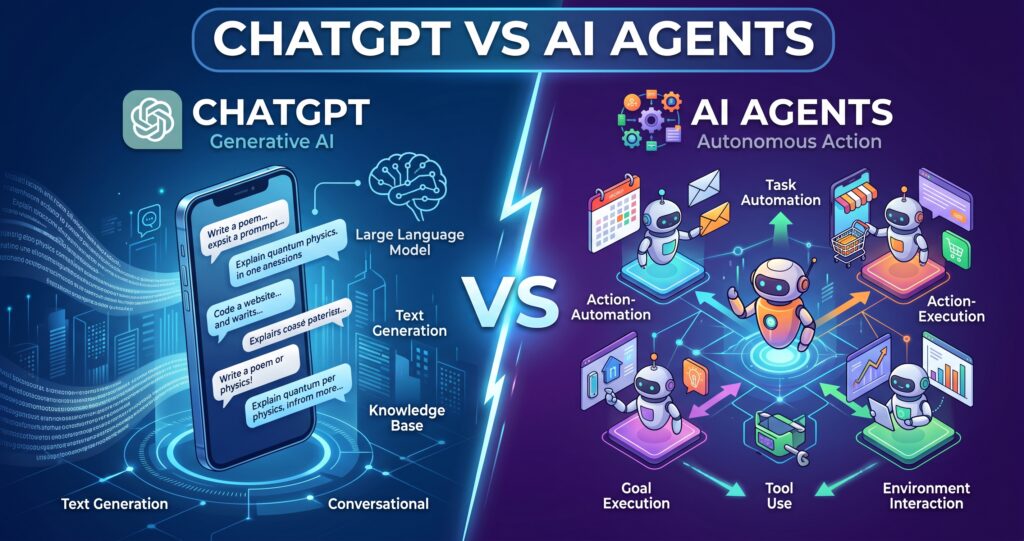
Published: May 2026 | Reading time: 8 minutes | By Euro Digi Tech Solution AI Agent vs ChatGPT: Which Should Your Business Use in 2026? TL:DR: ChatGPT is a conversational AI great for Q&A and content. AI Agents are autonomous systems that take action. For businesses targeting USA, UAE, Canada, and Australia — AI Agents often deliver better ROI for customer support, lead generation, and automation. Read on to understand when to use each. Introduction: The AI Landscape in 2026 If you’ve been following AI developments, you’ve probably heard the terms “ChatGPT” and “AI Agent” thrown around interchangeably. But they’re not the same thing — and choosing the wrong one could cost your business thousands in wasted resources. In 2026, the difference matters more than ever. ChatGPT excels at conversation and content creation. AI Agents excel at solving problems, making decisions, and taking action without human intervention. This guide breaks down the real differences, compares pricing, and helps you decide which technology is right for your business — whether you’re a small startup or an established agency in USA, UAE, Canada, or Australia. What is ChatGPT? (And What It Actually Does) ChatGPT is a large language model (LLM) built by OpenAI. It’s a conversational AI trained on massive amounts of text data to generate human-like responses. How ChatGPT Works: You ask a question → ChatGPT processes it It generates text based on patterns in training data It returns an answer → Conversation ends unless you ask another question No action is taken → It just responds with information ChatGPT’s Strengths: ✅ Excellent at answering questions and explaining concepts ✅ Great for content creation (blog posts, emails, social media) ✅ Fast learning curve — anyone can use it ✅ Affordable ($20/month for ChatGPT Plus, free version available) ✅ Works across industries and use cases ChatGPT’s Limitations: ❌ Doesn’t take actions (can’t book meetings, send emails, update databases) ❌ Requires human input for every task ❌ Knowledge cutoff — doesn’t know events after training ❌ No memory between sessions (unless you manually maintain context) ❌ Can’t integrate with business tools automatically What is an AI Agent? (The Game-Changer) An AI Agent is an autonomous system powered by AI that can perceive its environment, make decisions, and take action — all without human intervention. How an AI Agent Works: Define a goal → “Generate 10 qualified leads by Friday” Agent perceives context → Reviews customer data, market trends, etc. Agent makes decisions → Decides on strategy, messaging, targeting Agent takes action → Sends emails, updates CRM, schedules calls, creates tasks Agent monitors results → Tracks performance and adjusts AI Agent’s Strengths: ✅ Autonomous — works 24/7 without supervision ✅ Takes action — not just conversation ✅ Integrates with your business tools (CRM, email, calendar, etc.) ✅ Learns from results — improves over time ✅ Handles complex workflows automatically ✅ Massively increases efficiency and ROI AI Agent’s Limitations: ❌ Requires setup and configuration (not plug-and-play) ❌ Higher cost ($500–$5,000+/month depending on complexity) ❌ Needs clear goals and constraints defined upfront ❌ Requires monitoring — automation doesn’t mean “set and forget” ❌ Still relatively new — fewer proven templates Key Differences: ChatGPT vs AI Agent (Side-by-Side) Feature ChatGPT AI Agent Primary Function Answer questions, generate text Automate tasks, take action Autonomy Requires human prompts for each task Runs autonomously 24/7 Action Capability No — text only Yes — integrates with tools and APIs Integration Limited (API available, but manual setup needed) Deep integrations with CRM, email, calendar, etc. Learning/Adaptation No — each session is independent Yes — learns from outcomes and adjusts Setup Time Minutes — sign up and start Days/weeks — requires configuration Cost $0–$200/month $500–$5,000+/month Best For Content creation, Q&A, brainstorming Lead generation, customer support, automation Use Cases: When to Use Each Use ChatGPT When: You need to write content (blog posts, emails, social media) You want to brainstorm ideas for marketing campaigns You need quick answers to business questions You’re learning a new skill or topic You want personal productivity help (summaries, outlines, etc.) Your team is budget-constrained ($20/month is hard to beat) Use an AI Agent When: You need to generate qualified leads automatically You want 24/7 customer support without hiring staff You need to automate repetitive tasks (email follow-ups, data entry, scheduling) You’re losing revenue to manual processes that could be automated You want to qualify leads before your sales team talks to them You need consistent, scalable business processes Your business is in USA, UAE, Canada, or Australia — high-value markets where ROI matters Real-World Comparison: Case Studies Case Study 1: E-Commerce Store (USA) Goal: Answer customer questions 24/7 without hiring support staff. ChatGPT Approach: Customer service team uses ChatGPT to draft responses. Still requires human review and sends. Result: 20% faster responses, but still labor-intensive. AI Agent Approach: Agent deployed on website. Answers 90% of customer questions automatically, escalates complex issues to humans. Result: 70% fewer support tickets, 24/7 availability, $50K+ annual savings. Case Study 2: Digital Agency (UAE) Goal: Generate qualified leads for agency services. ChatGPT Approach: Use ChatGPT to write outreach emails. Team sends manually. Result: 5-10 leads per week, 8 hours/week labor. AI Agent Approach: Agent identifies target prospects, personalizes outreach, qualifies leads, books discovery calls. Result: 40+ leads per week, 2 hours/week labor, $200K+ annual revenue impact. Pricing Comparison: What You’ll Actually Pay ChatGPT Pricing: ChatGPT Free: $0/month (limited features, slower) ChatGPT Plus: $20/month (better performance, GPT-4 access) ChatGPT Teams: $30/user/month (for small teams) Enterprise: Custom pricing (large-scale deployment) AI Agent Pricing (Typical): Simple Agent (lead qualification): $500–$1,500/month Mid-range Agent (customer support + CRM integration): $2,000–$3,500/month Enterprise Agent (multi-function, custom workflows): $5,000–$10,000+/month Setup fees: Often $2,000–$5,000 one-time Key insight: AI Agents cost more upfront, but the ROI is typically 5–10x within 3–6 months for service businesses. Which Should You Choose? (The Decision Framework) Choose ChatGPT If: You’re just starting with AI and want to experiment Your primary need is content creation You have a small team with limited budget You want immediate access